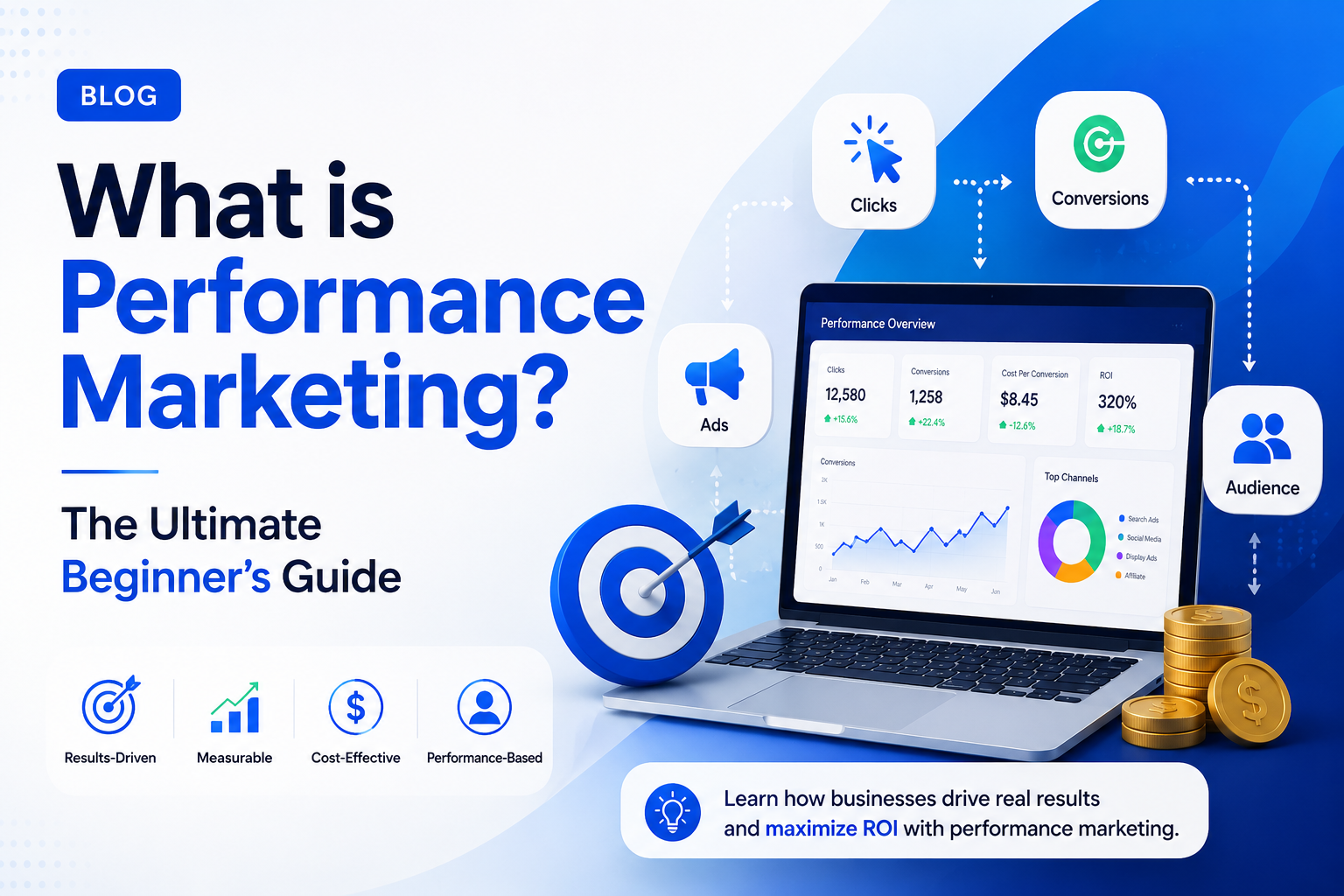

Pay only for real results. Discover how performance marketing works, which channels drive ROI, what metrics actually matter, and how to launch your very first campaign — from scratch.
- What is Performance Marketing?
- How Performance Marketing Works
- Key Players in the Ecosystem
- Top 7 Performance Marketing Channels
- Payment & Cost Models Explained
- Key Metrics & KPIs to Track
- Performance vs. Brand Marketing
- Step-by-Step: How to Get Started
- Top Platforms & Tools
- Best Practices & Common Mistakes
- The Future of Performance Marketing
- Frequently Asked Questions (FAQ)
Imagine running an advertisement where you only pay when someone actually buys your product — not when they see it, not when they scroll past it, but only when they complete a real, measurable action. That is the fundamental promise of performance marketing. And in an era where every marketing rupee needs to be justified, it is quickly becoming the most preferred model for businesses of all sizes — from bootstrapped startups to Fortune 500 enterprises.
Traditional advertising was always a gamble. You’d spend lakhs on a TV spot or a newspaper ad and hope it translated into sales somewhere down the line. There was no direct link between spend and outcome. Performance marketing changed that equation entirely by tying every single rupee to a trackable, attributable result.
1. What is Performance Marketing?
Performance marketing is a results-driven digital advertising strategy where advertisers pay only when a specific, pre-defined action is completed — such as a click, a lead form submission, a purchase, an app download, or any other measurable conversion event. Unlike traditional advertising (where you pay a flat fee for exposure regardless of outcome), performance marketing is entirely outcome-based: no results, no payment.
Think of it as the difference between hiring an employee on a salary versus hiring a salesperson who only gets paid on commission. The salaried employee gets paid whether or not they hit targets. The commission-based salesperson only earns when they produce results. Performance marketing operates on the commission principle applied to digital advertising.
The term “performance marketing” is broad enough to encompass several channels and tactics — paid search, paid social, affiliate marketing, display advertising, native advertising, and more — but they all share one defining characteristic: every dollar spent is tied to a measurable action.
A Brief History
Performance marketing as a formal concept emerged in the mid-1990s with the birth of affiliate marketing. Amazon launched one of the first major affiliate programs in 1996, allowing website owners to earn commissions by referring customers to Amazon. As the internet matured, Google launched AdWords in 2000, introducing the pay-per-click model at scale. By the 2010s, the proliferation of social media advertising platforms, mobile tracking technology, and sophisticated attribution tools transformed performance marketing into the sophisticated, data-driven discipline it is today.
Performance marketing = digital advertising where you pay only for verified, measurable actions — clicks, leads, sales, installs, or any custom conversion event you define.
2. How Performance Marketing Works
It is essential to grasp the science behind performance marketing before spending even a single rupee. The entire science comprises of four interdependent components, which include goal setting, traffic generation, tracking, and payment.
Cycle of Performance Marketing Campaigns
Every performance campaign follows a continuous cycle:
- Setting Objectives: It is determined by the marketer that how success will be measured i.e., through the purchase of the item, filling up a lead form, downloading anything, calling through phone, or doing anything else.
- Budget Setting and Target CPA Based on the margins on the item being sold, a target (CPA) is determined for each campaign.
- Running the campaign: The campaigns are run on selected media channels including search, social, affiliates and programmatic media.
- Traffic visits the landing page: The visitors of the advertisements reach the landing page prepared for this purpose.
- Triggering of Tracking: When the visitors complete the desired task, the tracking is triggered. Advertiser Payout: The advertiser pays for the conversion made and the publisher earns their commission.
- Optimization of Campaign: This is the stage where data analysis begins and the non-performing parts of the campaign are dropped while the performing ones are expanded.
The Role of Tracking Technology
Without proper tracking technology, the entire performance marketing model will cease to function. Without tracking technology, it would be impossible for you to identify which advertisement has generated what sales and consequently, there will be no way for you to reward the advertising agency. The tracking technology comprises of:
- Pixel: The name given to JavaScript code that is embedded onto your website (Meta Pixel, Google Ads Tag). When the user visits the website, the pixel gets triggered and tracks the visit/action back to the ad platform.
- UTM parameters: The UTM parameters include tags (?utm_source=google&utm_medium=cpc) that are added to the URL in order to send the traffic and conversion details to Google Analytics.
- Server-side tracking: Sending the conversion data from your servers to the ad platform rather than browser based cookies that could be blocked by the ad blockers or iOS privacy settings.
- Postback URLs (S2S tracking): Affiliates Marketing. The postback URLs help in sending a S2S call from the advertisers’ server to the affiliate network every time there is a conversion.
- Unique tracking links: Every affiliate/publisher gets their own URL. All sales resulting from the use of their unique URL are credited to them.
3. Key Players in the Performance Marketing Ecosystem
Performance marketing is a collaboration between many different parties, each having its own role to play.Knowledge of who is responsible for what is helpful in your navigation around the industry.
Advertisers (Brands)
Organizations or individuals promoting their offers through performance marketing campaigns. Advertisers decide about campaign objectives, action that will trigger a payout, and how much budget they will allocate. Example: e-commerce brand, SaaS, insurance company, mobile app developer.
Publishers (Affiliates)
Individuals or organizations generating traffic to the advertiser’s offer in return for a commission. Publishers might be bloggers, comparative sites, coupon websites, influencers on social media, newsletter owners, paid media experts placing the ads on behalf of the advertiser.
Affiliate Networks
Third-party platforms bridging the gap between advertisers and affiliates. These platforms provide tracking solution, handle payout and fraud prevention, and provide dashboards to both advertiser and affiliate. Examples of affiliate networks: Commission Junction (CJ), ShareASale, Impact, PartnerStack, Rakuten.
Ad Platforms
Platforms providing ad serving to specific audiences. While affiliate networks act as intermediaries, the difference is that ad platforms like Google, Meta, TikTok, and LinkedIn have access to huge databases of audience and ad inventories.
4. Top 7 Performance Marketing Channels (Explained in Detail)
Every performance marketing channel has its advantages, Here’s a deep dive into the most important ones:
1. Search Engine Marketing (SEM / PPC)
Pay-per-click advertising on Google and Bing drives the performance marketing industry. For example, when a user searches for “buy running shoes online” on Google, your ad shows up at the top of search results. You pay for your ad placement each time somebody clicks on it – this is why it’s called Pay-Per-Click (PPC).
Why it works: In search, you get highly intent-driven users. The user is already searching for what you’re offering. Essentially, he has raised his hand to say “I want this”. It is the closest digital analogy of a salesman meeting a prospect right before the point of conversion.
- Best for: Direct response, e-commerce, local services, B2B lead generation
- Cost per Click (CPC): ₹5-₹500+ depending on competitiveness of an industry
- Primary platform: Google Ads (90%+ market share in India), Microsoft Ads
- Key skillset: Keyword research, Quality Score optimization, ad copywriting
2. Social Media Advertising (Paid Social)
Meta (Facebook + Instagram), TikTok, LinkedIn, Pinterest, and Snapchat provide great targeting through demographics, interests, behaviors, life events, and lookalikes. In contrast to search advertising, where your ads are shown to those people who already need to buy something, paid social media advertising works best when it comes to creating demand among users that have never heard about your brand before but belong to your target audience.
- Best suited for: Brand awareness, e-commerce, app downloads, event signups, B2B lead generation (LinkedIn)
- Cost model: CPM/CPC/CPL/CPA (optimization)
- Key platforms: Meta Ads Manager, TikTok for Business, LinkedIn Campaign Manager
- Special competencies: Creative Strategy & A/B Testing
3. Affiliate Marketing
Affiliate Marketing is the pure form of Performance Marketing. Here you hire independent publishers (affiliates) who market your product through their platforms such as blogs, YouTube channels, newsletters, coupon websites and comparison platforms. The commission structure for your product (e.g., 10% of the sale) is decided by you, and your affiliates will be compensated only after getting a confirmed conversion. There is no budget wastage here since you do not have to pay anything for traffic that does not convert.
- Applicable to: E-commerce, SaaS, finance, insurance, travel
- Models of Commission: Sales-based commission, fixed commission on leads, tiered commission
- Popular Platforms: Impact.com, ShareASale, CJ Affiliate, PartnerStack, Awin
- Primary Skill: Affiliate discovery, commission model, anti-fraud measures
4. Display & Programmatic Advertising
Banner advertisement refers to the display of visuals in the form of banner advertisements over a large number of websites. Programmatic advertisement streamlines the purchase and sales process of these advertisements with the use of real-time data-based targeting. With the help of DSPs, advertisers are able to target customers according to their browsing pattern, past purchases, or demographics – even by tracking their activity across sites (retargeting).
- Best suited for: Retargeting, brand recognition, awareness
- Cost Structure: CPM (cost per thousand impressions) or CPC
- Popular platforms: Google Display Network, The Trade Desk, DV360, Criteo
- Primary skillset: Audience segmentation, creative designing, frequency capping
5. Native Advertising
Promotion that is seamlessly woven into the website’s stream is called Native Advertising. Native ads differ from banner advertisements since they blend into the surroundings and do not look like advertisement. The engagement level is very high while fatigue levels are kept low. Some firms that specialize in native advertising include Taboola, Outbrain, and MGID.
- Ideal use case: Promotion of content, brand story, finance, health products
- Pricing method: CPC or CPM
- Popular platforms: Taboola, Outbrain, MGID, Yahoo Gemini
- Primary skillset: Writing headlines, content strategy, optimizing landing pages
6. Email Marketing
Often overlooked as a “performance” channel, email marketing delivers some of the highest measurable ROI of any digital tactic — approximately ₹3,600 back for every ₹100 spent on average. Every metric is trackable: open rates, click-through rates, revenue per email, and cost per acquisition. Performance email marketing involves list segmentation, automation sequences, A/B testing subject lines, and optimizing for downstream conversions rather than just opens.
- Good for: Retention, upselling, abandoned cart recovery, lead nurturing
- Industry standard ROI: 36:1 (industry average)
- Main tools: Klaviyo, Mailchimp, ActiveCampaign, HubSpot
- Primary skill: Segmentation, automation, deliverability, copywriting
7. Influencer Marketing (Performance-Based)
The traditional approach to influencer marketing is the one-time payment approach where there would be a fixed payment for each post. However, performance influencer marketing makes it even better since the influencers would be provided unique codes for tracking and paid according to their results (sales, conversions).
- Best for: DTC brands, fashion, beauty, fitness, food & beverage
- Cost structure: Sale commission + additional flat fee
- Main platforms: LTK (Like To Know It), Creator.co, Grin, Aspire
- Primary skill set: Creator identification, UTM codes setup, offers design
5. Performance Marketing Payment Models Explained
Among all the confusions that may arise, the alphabet soup of cost models is one of them. Let us consider a complete description of all these models.
| Model | Full Name | You Pay When… | Best Used For | Risk Level |
|---|---|---|---|---|
| CPC | Cost Per Click | A user clicks your ad | Traffic generation, search ads | Medium |
| CPM | Cost Per Mille (1,000 impressions) | Ad is shown 1,000 times | Awareness, retargeting, display | High |
| CPL | Cost Per Lead | User submits contact info | B2B, insurance, real estate | Low–Medium |
| CPA | Cost Per Acquisition | A sale or conversion occurs | E-commerce, subscriptions | Very Low |
| CPI | Cost Per Install | A user installs the app | Mobile apps, gaming | Low |
| CPE | Cost Per Engagement | User interacts (watch, swipe, etc.) | Video, interactive ads | Medium |
| Revenue Share | Rev Share / Commission | A sale is made (% of value) | Affiliate programs | Very Low |
If you want to minimize your risks, CPA or CPL models would be the way to go – you will pay only when there is an actual outcome. After gaining enough experience and data, you could consider using CPC models such as (Google Search).
6. Key Metrics & KPIs Every Performance Marketer Must Know
Performance marketing is a numbers game. Knowing which metrics to track — and, more importantly, understanding what they mean and how they relate to profitability — is what separates good marketers from great ones.
Understanding Break-Even ROAS
One of the most important calculations in performance marketing is your break-even ROAS — the minimum return needed just to cover your ad costs without making a profit or a loss. The formula is simple:
Break-Even ROAS = 1 ÷ Gross Margin
Example: If your product sells for ₹2,000 and costs ₹1,200 to produce/fulfil, your gross margin is 40% (₹800 / ₹2,000). Your break-even ROAS = 1 ÷ 0.40 = 2.5×. Any ROAS above 2.5× means your campaigns are profitable.
The LTV:CAC Ratio — The Most Important Ratio in Marketing
Customer Acquisition Cost (CAC) is how much you spend to acquire one customer. Lifetime Value (LTV) is how much revenue that customer generates over their lifetime. The LTV:CAC ratio tells you whether your acquisition strategy is sustainable:
- LTV:CAC < 1:1 — You’re losing money. Stop scaling immediately.
- LTV:CAC = 1:1 to 2:1 — Breaking even or barely profitable. Optimize aggressively.
- LTV:CAC = 3:1 — The benchmark for a healthy, scalable marketing funnel.
- LTV:CAC > 5:1 — Excellent. You may be underinvesting — there’s room to scale.
7. Performance Marketing vs. Brand Marketing: Key Differences
A question that comes up in virtually every marketing team discussion: should we invest in performance marketing or brand marketing? The honest answer is that the most successful companies do both — but they understand the role each plays.
| Dimension | Performance Marketing | Brand Marketing |
|---|---|---|
| Main Objective | Elicit immediate measurable actions | Creation of awareness, perception, & loyalty |
| Payment Basis | Payment for outcomes (CPA, CPL, CPC) | Payment for impressions (CPM, flat fees) |
| Measurability | Extremely measurable — measurable outcome | Difficult to measure outcome |
| Timing | Smaller timeframe (hours-weeks) | Larger timeframe (months-years) |
| Scalability | Bound by audience saturation & size | Accretive over time |
| Risk | Low – associated with outcomes | Riskier – uncertain outcome |
| Creatives Used | Direct-response and offer-oriented | Emotionally-oriented and story-driven |
| Media | PPC, affiliates, retargeting, email | Television, public relations, sponsorships, content, OOH |
| Best Suited | New startups, ecommerce, growth phase | Well-established brand, market leader |
8. Step-by-Step: How to Get Started with Performance Marketing
Whether you have a ₹10,000 monthly budget or ₹10 lakh, this step-by-step framework applies at every scale. Follow it carefully and you’ll avoid the costly mistakes that most beginners make.
Define Your Conversion Goal & Set a Target CPA
Before doing anything else, decide exactly what action you want users to take. Be specific: not “I want more sales” but “I want 50 product purchases per month at a maximum cost of ₹600 per sale.” Your target CPA should be based on your gross margin. If your product earns ₹1,500 profit per unit, a CPA of ₹600 gives you a 2.5× return — profitable enough to scale.
Understand Your Target Audience Deeply
Audience personas should always be defined before designing any kind of advertisement. Who are your target audience in terms of their demographics, problems, motivations, online behavior? Which keywords do they use? Which content do they read? The more information you have about your audience, the easier it will be for you to target them, and that is the essence of advertising. There are many tools that can help in analyzing an audience, such as Facebook Audience Insights, Google Keyword Planner, SparkToro.
Choose Your Starting Channel (Don’t Spread Thin)
One of the most common beginners’ mistakes is attempting to spread across all channels at once. Select just ONE primary channel depending on where your audience is located and what you want to achieve. If it is intent-driven customers who are already looking for your products via search engines, launch Google Search Ads first. If the aim is product discovery or visuals, choose Meta or Instagram Ads. For B2B lead generation, start with LinkedIn Ads.
Set up your Conversion Tracking BEFORE Investing Any Money
This is something you HAVE to do. You need to have your tracking codes added (GA Ads conversion tracking code, Facebook Pixel, TikTok Pixel) and have your conversions set up in GA4. Make sure everything is tracked properly prior to launch. Test your setup by actually performing the task and seeing if it gets tracked.
Build a High-Converting Landing Page
Your ad drives traffic; your landing page converts it. A great landing page has: (1) a headline that matches the ad’s promise, (2) a clear and singular call-to-action, (3) social proof (reviews, ratings, customer logos), (4) a fast load time under 3 seconds, and (5) mobile optimization since 60%+ of clicks in India come from mobile. Avoid sending paid traffic to your homepage — it’s too generic. Build dedicated landing pages for each campaign.
Run your test with a budget and gather data
To start, allocate 15-20% of your budget per month for the first two weeks. Experiment with at least 2-3 different versions that will use various headlines, visuals, and propositions. Run your experiment at least on 2 different samples of your targeted audience. Now, the important point here is gathering data, not earning money.
Analyze, Optimize & Scale What Works
After the test phase, cut any campaign or ad that is performing above your target CPA. Double down on campaigns hitting or beating your target. Raise budget allocation by 20-30% every 5-7 days. On Meta and Google’s algorithm-driven platforms, sudden large budget increases can destabilize campaign learning and spike your CPA temporarily.
9. Top Platforms & Tools for Performance Marketing
The use of appropriate tools increases your speed of setting up and managing performance marketing campaigns. Below is an organized list of some of the key platforms you should consider using:
Google Ads
The world’s largest PPC network that includes search, display, shopping, YouTube, and Performance Max campaigns.
Meta Ads Manager
Run campaigns across Facebook, Instagram, and Messenger. Powerful AI-driven audience targeting and creative optimization.
TikTok for Business
Freshest social media advertising tool to target Gen Z and millennials using in-feed ads.
LinkedIn Ads
Number 1 B2B performance marketing platform. Job titles, companies, industries, seniority targeting.
Impact.com
Affiliate and partnership management platform. Recruitment, tracking, payments, and fraud detection automation.
Google Analytics 4
Free and enterprise version of analytics platform. Offers conversion path, audience, attribution, and campaigns tracking.
Triple Whale
Software for e-commerce attribution and analytics. Aggregates all your information from the ad networks into one place to find out ROAS and profitability.
VWO / Unbounce
Page maker and A/B tester. Make and manage landing pages without writing any code.
10. Best Practices & Common Mistakes
Best Practices That Actually Move the Needle
Prioritize First-Party Data
As third-party cookies fade away, your first-party data — your email list, CRM database, purchase history, and app data — becomes your most valuable targeting asset. Upload these lists as custom audiences to Meta and Google, then build lookalike audiences that mirror your best customers. Brands with strong first-party data consistently achieve 20–40% lower CPAs compared to those relying on platform-native audiences.
Embrace AI Bidding (But Feed It Data)
Google’s Smart Bidding (Target CPA, Target ROAS) and Meta’s Advantage+ campaigns use machine learning to optimize in real time across millions of signals. These automated strategies consistently outperform manual bidding — but only once you have sufficient conversion data. As a rule of thumb, aim for at least 30–50 conversions per month per campaign before switching to automated bidding. Below that threshold, the algorithm doesn’t have enough data to learn effectively.
Make Creative Your Main Lever
Audience targeting is being automated more and more. What’s left to you to leverage is your creative – copy, visuals, video, and hook. Studies by Meta reveal that up to 70% of variance in campaign performance is due to the quality of creative rather than targeting and bidding. Make heavy investments in creative optimization: use at least 3–5 ads per campaign, change your creative every 2–4 weeks to avoid ad fatigue, and prioritize video (especially shortform video under 15 seconds) and UGC (user-generated content).
Run Full-Funnel Campaigns, Not Just Bottom-Funnel
Many beginners only run conversion-focused ads (bottom of funnel). This is a mistake for medium-to-long buying cycles. The most efficient performance marketers build all three funnel stages: awareness (video views, reach campaigns), consideration (traffic, engagement, lead gen), and conversion (purchases, form fills). Nurturing users through the funnel often results in lower CPAs than trying to cold-convert strangers directly.
Common Mistakes to Avoid
❌ Launching Without Tracking
Running ads before setting up conversion tracking means you have no idea what’s working. Every rupee is essentially wasted until tracking is verified and live.
✅ Always Check Your Tracking First
Run a test conversion yourself and make sure it triggers in your analytics platform before starting any paid campaigns. It’s non-negotiable.
❌ Scaling Before Profitability
Increasing budget on a campaign that isn’t yet at or below your target CPA will only lose money faster. Scale winners, kill losers.
✅ Meet Target CPA First, Then Scale Up
Don’t scale up your budget until your campaign maintains your target CPA for at least 7 to 14 days. Budget increases of 20 to 30 percent are more conservative.
❌ Sending Traffic to the Homepage
Your homepage serves many audiences. A paid ad with a specific message needs a dedicated landing page that matches that message — otherwise conversion rates plummet.
✅ Make Campaign-Specific Landing Pages
Make a unique landing page for each of your campaigns or ad groups. This is one of the most impactful CRO optimizations out there.
❌ Ignoring Creative Fatigue
Showing the same ad to the same audience repeatedly causes performance to decline rapidly. Frequency caps and creative rotation are absolutely necessary.
✅ Rotate Creatives Every 2 to 4 Weeks
Always build out your creative pipeline so that you’re ready to run new creatives all the time. Check your frequency metrics, and once they’re above 3 to 4, switch up your creatives.
11. The Future of Performance Marketing in 2026 and Beyond
Performance marketing is evolving rapidly. Here are the key trends reshaping the discipline right now:
AI-Generated Creative at Scale
Generative AI tools (like Meta’s Advantage+ Creative, Google’s asset generation, and third-party tools like AdCreative.ai) are enabling brands to produce hundreds of ad variations at the click of a button — testing different headlines, visuals, and CTAs simultaneously at a scale that was previously impossible. The competitive advantage is shifting to marketers who can effectively prompt, evaluate, and iterate on AI-generated assets.
Privacy-First Tracking & Cookieless Attribution
Apple’s App Tracking Transparency (ATT) and evolving browser privacy standards have significantly degraded cookie-based tracking. The future belongs to server-side tracking, Modeled Conversions, and Privacy-Enhancing Technologies (PETs). Marketers who invest in their first-party data infrastructure and server-side conversion APIs today will have a significant advantage as privacy restrictions tighten further.
Retail Media Networks
Amazon, Flipkart, Myntra, and other large retailers are building their own performance advertising networks. These “retail media” platforms allow brands to serve highly targeted ads to shoppers who are already in a buying mindset — and attribution is near-perfect because it happens entirely within the retailer’s ecosystem. Retail media is the fastest-growing segment of performance marketing globally.
Connected TV (CTV) Performance Advertising
Streaming platforms are increasingly offering performance-based ad buying for TV — allowing brands to target specific household profiles and track downstream conversions (website visits, app installs, store visits) driven by TV ads. This blurs the line between brand and performance advertising in an exciting new direction.
❓ Frequently Asked Questions
Performance marketing is a form of online advertisement whereby you are billed only after certain actions have taken place. This means that you are billed when the visitor clicks on the ad, completes a web form or buys your product. This is the reverse of traditional marketing because in the traditional model, you pay once and the payment does not guarantee any results since it’s just an attempt at catching the customer’s attention.
Digital marketing refers to a vast range of online marketing strategies that include SEO, content marketing, social media, email marketing, and paid online marketing efforts. Performance marketing is a distinct segment of digital marketing that is characterized by every campaign being based on paying for results rather than paying for exposure or views. Every performance marketing effort is a form of digital marketing, but not all digital marketing campaigns can be regarded as performance marketing campaigns. For instance, an SEO content marketing strategy is digital marketing, but it is not performance marketing.
The answer to this will depend entirely on your gross margin. ROAS has to be higher than the break-even ROAS (1 ÷ gross margin %). For most e-commerce companies who earn profits of 30-50%, a 3-5× ROAS is good. High-margin companies (digital products, software-as-a-service) will make profits even with a 2× ROAS. Lower-margin companies would need 8-15× ROAS.
🚀 Ready to Launch Your First Performance Campaign?
Performance marketing is arguably the most effective, trackable, and scalable approach for building a company in the digital world. Begin with defining your objective, tracking everything rigorously, testing extensively, and scaling only what works profitably.
📈 Start Your First Campaign →