
What is off-page
SEO, really?
The part of SEO that happens far away from your website — backlinks, brand mentions, and reputation — that quietly decides whether search engines trust you enough to rank you.
If you’ve published a blog post, optimized your title tags, and still watched your site sit quietly on page four of Google — you’ve run into the limits of on-page SEO alone. That’s where off-page SEO comes in.
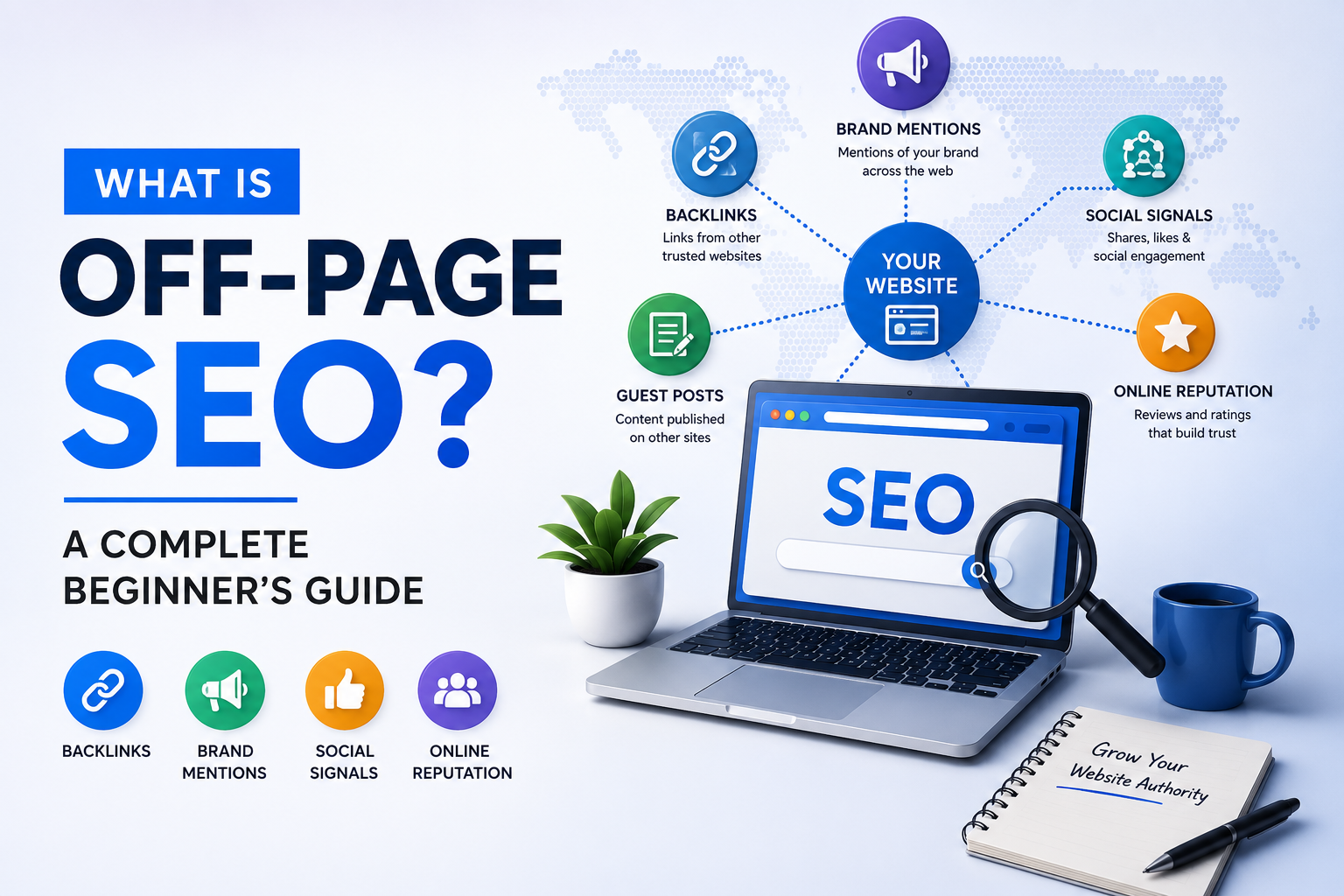
Off-page SEO is the set of actions taken outside your own website to improve how it ranks. Search engines don’t just read what your page says about itself — they weigh what the rest of the internet says about you, too.
Off-page SEO includes:
- Backlinks from other websites
- Brand mentions across the web, linked or not
- Social media engagement and shares
- Guest posting and digital PR
- Influencer collaborations
- Online reviews and reputation management
- Forum and community participation
- Local citations, for businesses with a physical presence
Think of it as the internet’s voting system: the more relevant, high-quality votes your site earns, the more a search engine trusts that it deserves to rank.
On-page vs. off-page vs. technical SEO
It helps to see where off-page SEO sits inside the bigger picture before going further.
| SEO type | What it covers | Who controls it |
|---|---|---|
| On-page SEO | Content, keyword usage, title tags, headers, internal links, images | You, fully |
| Technical SEO | Site speed, crawlability, mobile-friendliness, structured data, HTTPS | You, fully |
| Off-page SEO | Backlinks, brand mentions, social proof, reviews, PR | Partly you, mostly earned |
New to the topic? Get comfortable with the fundamentals in our on-page SEO guide and technical SEO checklist before layering off-page work on top — off-page rarely rescues a slow, poorly structured site.
Why off-page SEO matters
Search engines weigh hundreds of signals, but trust and authority are consistently among the strongest. Off-page SEO is how you build both.
Signals of authenticity
Backlinks from reputable sites serve as an endorsement of your content.
Domain Authority
The third party’s level of authority depends on the authority of the sites that link back to yours.
Generating referral traffic
The backlink serves as a passageway that enables real visitors to visit your website.
Improves credibility
Recommendations and comments are among those types of validation that can affect how your brand is perceived.
Core off-page ranking factors
Not every off-page signal carries equal weight. These matter most.
Backlinks – quality is better than quantity
Fewer but quality backlinks are better than lots of low-quality backlinks. The search engine takes into consideration.
- Relevance — Is the linking site relevant to your industry?
- Authority — does the linking domain have real standing of its own?
- Anchor text — is it natural, or over-optimized?
- Placement — editorial, in-content links outweigh footer links.
Domain and page authority
Third-party metrics that estimate ranking potential, based largely on a site’s backlink profile.
Brand mentions, linked or not
Even an unlinked mention of your brand can register as a trust signal — often called an “implied link.”
Social signals
Shares and likes aren’t a direct ranking factor, but visibility increases the odds your content gets discovered and cited by others.
Reviews and reputation
For local and e-commerce sites, reviews on Google Business Profile and industry directories shape both rankings and click-through rate.
Local citations
Consistent name, address, and phone number (NAP) listings across directories strengthen local search visibility.
10 proven off-page SEO techniques
An ideal approach combines more of these than just sticking to one.
Guest blogging
Produce for credible websites within your area of expertise in exchange for an editorial backlink.
Digital PR
Conduct original research and create data studies that will be quoted by journalists.
Broken link building
Spot broken links on websites and offer them your piece of content to link to.
Skyscraper Method
Create something that is better than the existing ranking content and get in touch with websites linking to the original blog post.
Influencer Collaboration
Collaborate with the influencers from your industry.
Citation Building
Getting listed in Google My Business, Bing Places, and other local directories.
Social Media Posts
Posting regularly in the social media channels that have your targeted audience.
Community engagement
Active participation in forum discussions, Reddit and Quora.
Podcast & video guesting
Guest appearances at podcasts or video platforms which typically get links from the description or notes.
Press outreach
Answer the questions of journalists in order to receive backlinks from high-quality sources.
How to develop an off-page SEO strategy
Analyze your backlinks
Find out how many domains point to your website and how good they are. Also, know from which sources your competitors get their backlinks.
Analyze your competitors’ backlinks
Discover sites that link to your competitors but don’t link to you; these will form your list of target outreach prospects.
Create unique and valuable link-worthy content
These might include guides, studies, or whatever kind of content that stimulates natural backlinks.
Focus on relevancy
Having 10 relevant backlinks from reputable sources is always better than having 100 links from sites unrelated to your website.
Generate links from different sources
For example, through guest blogging, PR, directories, citations, etc
Check the process monthly
Off-page SEO needs time; use monthly referral domains, ranking and traffic reports to track your results.
Maintain a good reputation online
Ask your happy customers to leave feedback and respond appropriately to negative reviews.
A great combination for keyword strategy. For more info about the keyword strategy basics, see our guide. If you have a local business, try our local SEO checklist.
Common off-page SEO mistakes
- ✕ Buying links in bulk from low-quality, unrelated sites
- ✕ Over-optimizing anchor text with the exact same keyword every time
- ✕ Ignoring relevance in favor of raw link volume
- ✕ Chasing quantity over quality
- ✕ Neglecting unlinked brand mentions
- ✕ Treating it as a one-time task instead of an ongoing effort
Paid, low-quality link schemes can violate Google’s spam policies and lead to manual penalties — so build for the long term.
Tools to track your progress
Regular backlink audits with these tools help you catch toxic links early and spot fresh opportunities before competitors do.
Frequently Asked Questions
Difference between on-page SEO and off-page SEO?
On-page SEO is an optimization of elements present on the site itself, for example, content and meta tags. Off-page SEO provides you with authority with backlinks and other off-site factors like brand mentions and reviews.
When am I expected to see the results of off-page SEO?
Off-page SEO results would normally take anywhere between three to six months to be achieved.
Is the significance of backlinks going to reduce by 2026?
No. Even though search engines apply very advanced algorithms, backlinks continue to be one of the strongest authorities signals.
Is off-page SEO bad for my website?
Yes. It can be if you use incorrect off-page SEO techniques. Make sure to create useful content and seek out links through natural marketing efforts.
Which is the simplest way to start off?
Guest blogging and local citations can be achieved with minimum effort on the part of beginner SEOs – they take time but not money.
Does sharing of content in social media help SEO?
It does not directly affect rankings according to Google’s official position. However, social presence helps content to gain visibility and get linked.
Final thoughts
Off-page SEO is not a one-time process; it is an ongoing commitment towards credibility of your website. It is what makes people across the web and search engines trust and recommend you after laying the right foundations through on-page and technical SEO.
It does not take much to begin – conduct a backlink analysis, create quality content for which links would make sense, and then reach out to other websites genuinely. The result of your efforts multiplies, as do your rankings, traffic, and credibility.