
What Is GEO (Generative Engine Optimization)? SEO vs GEO Explained
But a few years ago, getting to number one on Google was the end game. Today a growing number of people never reach page one at all. The ask ChatGPT, Gemini, Perplexity or Google’s AI Overviews, read the neat answer, and move on. If your brand isn’t inside that answer, you’re invisible to them. So, what is generative engine optimization? It’s the practice of making your content easy for AI tools to understand, trust and cite.
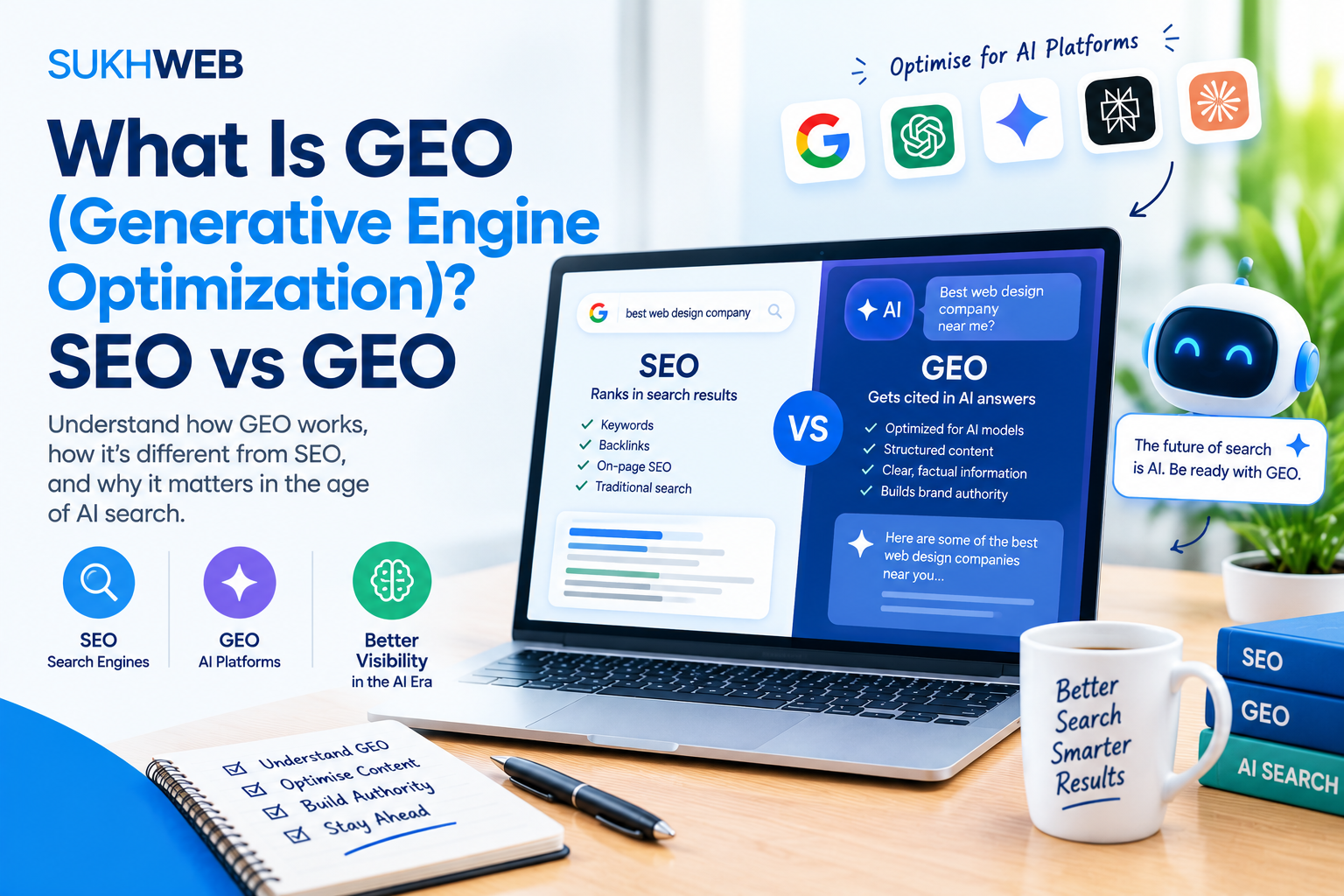
Short answer: Generative Engine Optimization (GEO) is the practice of structuring, writing and promoting your content so AI-powered search tools can understand it, trust it and cite it when they generate answers. SEO earns you a ranking. GEO earns you a mention.
What Is GEO (Generative Engine Optimization)?
Generative Engine Optimization is the discipline of making your content easy for large language model (LLM) powered search tools to find, interpret and quote. The “generative engines” in question include ChatGPT with search, Google Gemini and AI Overviews, Perplexity, Microsoft Copilot and Claude. Unlike a classic search engine that hands you ten blue links, these tools read multiple sources and write a single response.
The term entered the mainstream after a 2023 research paper from academics at Princeton and other institutions, titled GEO: Generative Engine Optimization. In their experiments, the scientists tried various modifications of the content and discovered that certain modifications, like including credible citations, quotations, and statistics, were able to increase its presence in responses significantly. That was one of the first public signs that visibility inside AI answers can be influenced on purpose.
You’ll also hear GEO called AI search optimization, LLM optimization (LLMO) or answer engine optimization (AEO). The labels differ, but the goal is the same: become the source a machine reaches for when it needs to explain something in your field.
Why GEO Matters Right Now
The search process is splitting. Navigational and transactional searches continue to rely on the older results. However, the informational, comparative, and “how do I” searches are rapidly heading towards conversational tools. In fact, Google itself now displays AI-powered summaries ahead of the regular results, and you can find out the details from Google’s guidelines for AI features and your website.
This results in a transformation of the economy of visibility in three ways.
- Clicks down, clout up. An AI-powered answer may well answer the need of the searcher without any click at all. Even then, the presence of your name in that summary means increased clout even without clicks.
- Winner-takes-most citations. A results page has ten slots. The answer given by the AI could cite a few source. The competition for each of these spots will be all the more fierce.
- Trust compounds. When an AI recommends a brand, readers treat it like a recommendation from a knowledgeable friend. The coming ones will more likely be closer to making their decision.
None of the above statements indicate organic search is dead. It means there is now a second surface where your content competes, and most websites aren’t built for it yet. If you’re still building your foundation, start with our beginner’s guide to SEO and come back here.
How AI Engines Choose What to Cite
Nobody outside these companies knows the exact recipe, and it changes often, so be wary of anyone promising a guaranteed formula. Still, the way these systems work gives us useful clues.
Most modern AI search tools use a pattern called retrieval-augmented generation. In plain terms: the tool takes a question, retrieves relevant pages from a search index, pulls out the passages that seem most useful, and then asks the language model to write an answer grounded in those passages. Two things follow from that.
First, you still need to be findable. If your page isn’t crawlable, indexed and reasonably authoritative, it never enters the pool of candidates. This is why technical SEO remains the entry ticket.
Second, the model prefers passages that are easy to lift. A paragraph that opens with a clear definition, states a specific fact and stands on its own is far easier to quote than a rambling section that needs three earlier paragraphs for context.
Think of an AI engine as a very fast research assistant with a short attention span. It rewards the source that answers cleanly and shows its evidence.
Beyond individual pages, engines also appear to weigh how often and how consistently a brand is mentioned across the wider web: reviews, forums, news coverage, industry lists and expert commentary. Being discussed in credible places gives the model more signals that you are who you claim to be.
SEO vs GEO: The Real Differences
SEO and GEO share DNA. Both reward helpful, accurate, well-organized content. The differences lie in the target, the format and the measurement.
| Factor | Traditional SEO | GEO |
|---|---|---|
| Main goal | Rank high on the results page | Be cited or recommended inside AI answers |
| Unit of competition | The whole page | A single passage or fact |
| Query style | Short keywords | Long, conversational questions |
| Key signals | Backlinks, relevance, page experience | Clarity, evidence, entity trust, brand mentions |
| Content format | Keyword-targeted pages | Direct answers, data, definitions, structured sections |
| Success metric | Rankings, organic traffic | Citation frequency, share of voice, referral visits |
| Feedback speed | Weeks to months | Can shift faster, but is less predictable |
The mindset shift
SEO asks, “How do I outrank the other pages?” GEO asks, “If a machine had to explain this topic in four sentences, would it use mine?” That latter question drives you to write more concisely, with better supporting evidence and fresh ideas – all beneficial to human readers as well.
Does GEO Replace SEO?
No, and treating it that way is the most expensive mistake you can make. Generative engines rely on indexed web content, so the fundamentals of crawlability, site speed, internal linking and topical authority still decide whether you are even considered. GEO is best understood as a layer on top of strong SEO, not a substitute for it.
A practical way to think about it: SEO gets you into the room, GEO gets you quoted once you’re inside. Teams that already publish helpful, expert-led content have a head start. If that’s you, our SEO page explains how we extend an existing strategy to cover AI visibility.
8 GEO Tactics That Work
These are practical moves grounded in how retrieval-based systems work and in what published research suggests. There is no magic to any of them, and there are no guarantees. They do reliably make content clearer and more credible.
1. Lead with the answer
Place a direct, self-contained answer right under each heading, ideally in the first two sentences. Then expand with detail. It is the same way that AI technologies do and it also assists those who skim through reading materials.
2. Back claims with evidence
Add statistics, named sources, dates and short expert quotes where they genuinely belong. Link to primary sources, such as original studies or official documentation, rather than to other blog posts summarizing them. The Princeton paper above found that content with citations and concrete data tended to perform better in generated answers.
3. Write for conversational questions
People ask AI tools full questions: “What’s the difference between SEO and GEO for a small business?” You can take advantage of your customer’s questions and develop the answers to make your FAQs page. Tools like AlsoAsked or your own sales-call notes are a goldmine.
4. Use clean structure
Descriptive headings, short paragraphs, lists and tables make passages easy to separate and quote. Each section should make sense on its own, without needing the reader to have seen the section above it.
5. Add structured data
Schema markup tells machines exactly what a page contains: an article, an FAQ, a product, an organization. Use the vocabulary at Schema.org and validate your markup with Google’s Rich Results Test.
6. Build entity clarity and E-E-A-T
Make it obvious who you are, what you do and why you’re qualified. Use real author bios with credentials, a detailed About page, consistent business details and links to your profiles elsewhere. Google’s guidance on helpful, people-first content is still the best public description of the experience and expertise signals that matter.
7. Earn mentions beyond your own site
AI engines look at what the wider web says about you. Contribute expert commentary, get included in credible roundups, encourage genuine customer reviews, and take part in the communities where your audience asks questions. Digital PR and GEO overlap heavily.
8. Publish something original
Generative engines have no shortage of generic summaries. What they can’t invent is your proprietary data, your case studies, your survey results or your hard-won opinion. Original research gives a model a reason to cite you specifically. If you need a starting point, see how we approach content strategy.
Don’t forget the unglamorous basics: allow reputable crawlers in your robots.txt if you want to be cited, keep pages fast and mobile friendly, and keep key information in text rather than locked inside images or scripts that a crawler may skip.
How to Measure GEO
Measurement is the weakest part of GEO today, because AI platforms don’t give you a Search Console equivalent. You can still build a sensible picture with a few habits.
- Run a prompt audit. List 20 to 50 questions your customers ask. Run them monthly in ChatGPT, Gemini and Perplexity and record whether you’re mentioned, cited or ignored, and which competitors appear.
- Track AI referral traffic. In Google Analytics, look for visits from domains such as chatgpt.com and perplexity.ai. Volumes are small for most sites, but conversion quality is often strong.
- Watch branded search. If more people are searching your name after AI exposure, that lift shows up in branded query trends.
- Check sentiment and accuracy. Note whether AI tools describe your business correctly. Wrong facts are a fixable problem, usually by clarifying and consolidating information on your own site.
Tools for GEO tracking have started to appear, and online resources like Search Engine Land provide information about these developments as they occur. Treat any single number with caution, since AI answers vary from one run to the next.
Common GEO Mistakes to Avoid
- Abandoning SEO. Without an indexed, trusted site, there’s nothing for GEO to build on.
- Stuffing content with fake stats or quotes. Engines and readers both punish inaccuracy, and fabricated sources destroy trust.
- Mass-producing AI-written filler. If your page says what fifty others say, there is no reason for a model to choose it.
- Chasing hacks. Hidden text and prompt-injection tricks may backfire as platforms tighten their defenses.
- Ignoring off-site reputation. Your own blog is only one voice. What others say about you carries weight.
- Expecting instant results. Models update on different schedules, and citations can take time to shift.
A Simple 30-Day GEO Starter Plan
Week 1: Audit. Build your list of target questions, run the prompt audit and note where competitors are cited instead of you. Make sure your important pages can be indexed.
Week 2: Fix the foundation. Add author bios, tidy your About and service pages, and implement Article, FAQ and Organization schema on priority pages.
Week 3: Improve your best content. Top 5 pages must be updated with the answer-first format, statistics, headings, and FAQ section. Link out to primary sources.
Week 4: Earn mentions. Send out one piece of original information or quotation to suitable publications, update your company listings, and ask for reviews from satisfied customers. Then re-run your audit and compare.
Frequently Asked Questions About GEO
Is there any difference between GEO and SEO?
No. They have some similarities, but while SEO is about getting into the ranking of results, GEO is about citations in AI-generated answers. SEO has to be good before GEO.
What does GEO stand for?
GEO stands for Generative Engine Optimization. Some people also call it AI search optimization, LLM optimization or answer engine optimization.
Does GEO work for small businesses?
Yes. Small businesses can compete by being specific: local expertise, niche topics, genuine reviews and clear, factual answers to the questions customers actually ask.
How long does GEO take to show results?
It varies. Some changes appear in AI answers within weeks, especially on tools that search the live web. Building the off-site reputation that drives consistent citations usually takes several months.
Can I guarantee my brand appears in ChatGPT or Gemini?
No one can. Beware of anyone who promises it. You can improve your odds by being clear, credible and widely referenced, but the platforms control their own outputs.
Final Thoughts: Optimize for People, and Machines Will Follow
GEO can sound like a brand-new game, but its heart is old-fashioned: say something useful, say it clearly, prove it, and make sure the right people know you said it. The difference now is that a machine reads your work before many humans do. Write with that reader in mind and you’ll serve both.
Start small. Pick one high-value page this week, rewrite it with an answer-first structure and real evidence, and see how AI tools respond in a month. Then keep going. Brands that learn this early will be the names AI engines reach for later.