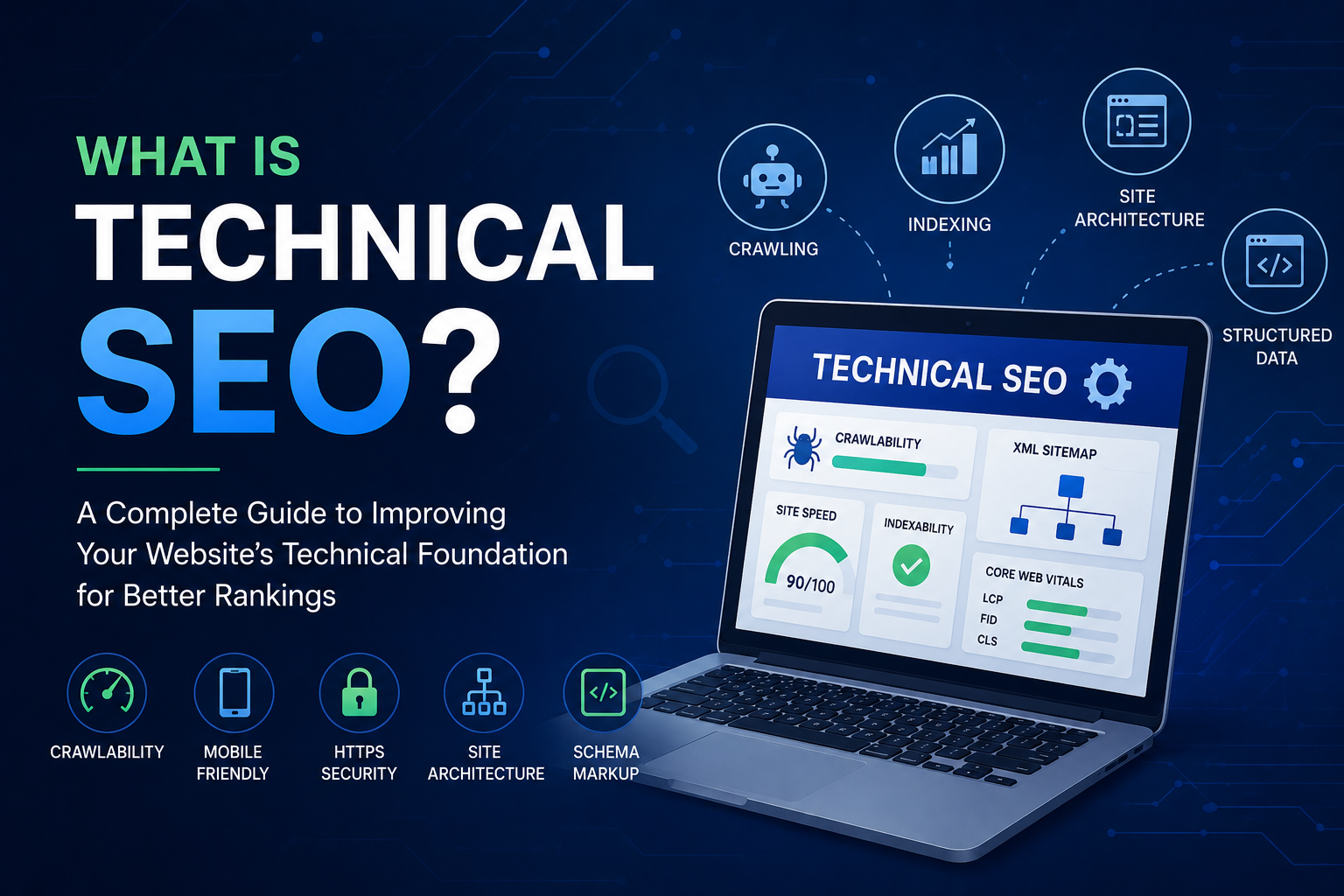

What Is Technical SEO?
A complete, beginner-friendly checklist for making sure search engines can actually crawl, render, and trust your website — before you worry about anything else.
If you’ve spent hours polishing blog content, chasing keywords, and building backlinks — but your rankings still won’t budge — The problem probably isn’t your writing. It’s your website’s foundation — understanding what is technical SEO is more important than ever in 2026
Search engines have grown far more sophisticated. Google’s crawlers now evaluate site speed, mobile usability, structured data, JavaScript rendering, and dozens of other behind-the-scenes signals before your content ever gets a chance to rank. Skip technical SEO, and you’re asking Google to find treasure in a maze with no map.
This guide breaks down exactly what technical SEO is, why it’s non-negotiable in 2026, and hands you a complete, interactive checklist you can start working through today.
Technical SEO, simply put
The back-end efforts that allow search engines to find, interpret, and believe in your content.
Technical SEO is the optimization of a website’s backend structure in such a way that search engines like Google and Bing — as well as the more modern AI-powered Search Engines – can crawl, render and index your pages effectively. In contrast to on-page SEO and off-page SEO, technical SEO is not concerned about any specific aspects of your site; instead, it deals with everything going on behind the scenes.
For example, on-page SEO may be compared to the furniture in a house, while technical SEO is the wiring and plumbing. Even though the furniture might look nice, if there are any problems with plumbing, you will quickly leave the place — just like search engines do if there are any problems on your site.
Based on what Google Search Central says, an optimized website is one of the main requirements of Google to your website if you want to be ranked.

Why technical SEO matters more in 2026
Search has changed fast. Here’s what’s raising the stakes this year.
AI Overviews need clean data
Generative search pulls from well-structured, crawlable pages. Broken schema or blocked resources make you invisible, no matter how good the writing is.
Core Web Vitals still count
Loading speed, interactivity, and visual stability remain part of Google’s ranking systems — and of whether visitors stay or bounce.
Mobile-first is the default
The Google bot indexes using the mobile version of your website. A desktop-optimized-only site is now a liability, not a nice-to-have gap.
JavaScript sites need help
React, Vue, and Next.js power more of the web every year. Rendering issues are now a leading cause of pages that quietly fail to index.
Crawl budget is precious
As the web grows, search engines allocate limited attention per site. Duplicate pages and broken links waste budget your real pages need.
The complete 2026 technical SEO checklist
Ten modules, built for beginners. Check items off as you go — your progress tracks live at the top of the page.
Crawlability essentials
Indexability Audit
Site Structure and URL
Page speed & Core Web Vitals

Mobile optimization
Security & site health
Structured data
JavaScript SEO
International SEO
Ongoing maintenance
Common mistakes worth avoiding
Even experienced site owners trip over these.
Blocking CSS/JS in robots.txt
This stops Google from properly rendering and understanding your pages, not just individual files.
Ignoring mobile usability
With mobile-first indexing, this is one of the costliest gaps a site can have today.
Neglecting redirect chains
Multiple hops slow down crawling and quietly dilute the link equity you’ve earned.
URL parameters run wild
Filters, sorting, and tracking parameters can generate thousands of near-identical pages.
Treating this as “set and forget”
Sites evolve and algorithms shift — technical health needs a recurring check-in, not a one-time fix.
Essential tools for technical SEO
You don’t need all of these on day one — start with the free ones.
| Tool | What it’s for |
|---|---|
| Google Search Console | Free, essential monitoring of crawl and index status. |
| PageSpeed Insights | Core Web Vitals and performance auditing, powered by Lighthouse. |
| Screaming Frog | Deep-crawl audits, ideal for larger or more complex sites. |
| Ahrefs / Semrush Site Audit | Ongoing, automated technical health monitoring. |
| Schema.org | The reference vocabulary for structured data markup. |
If you’re just getting started, pair this checklist with our guide on on-page SEO best practices and our complete keyword research guide to round out your strategy.
Frequently asked questions
Technical SEO vs On-Page SEO?
Technical SEO relates to the structure of a website, which consists of crawling, indexing, speed, and security of the website, while on-page SEO is concerned with content of a website such as keywords, headings, and meta tags.
How Frequently You Should Perform a Technical SEO Audit?
One full technical SEO audit should be performed quarterly, and more frequent, but shorter checks such as Search Console review – weekly or monthly, especially after any significant change in the website.
Can I Do Technical SEO Without Coding Skills?
Yes. Sitemap submission, broken link fix, and analysis of search console report do not require any coding knowledge. However, sometimes you may have to solve issues related to JavaScript rendering with the help of a developer.
Do We Have to Care about Core Web Vitals for Ranking in 2026?
Yes, we have to. Google uses page experience signals, including Core Web Vitals, as one of the ranking factors. Content quality is definitely more important, but poor page experience will stop other good websites from ranking.
There is one thing that you should do first of all?
It is essential that your website should be accessible and indexed from the very beginning. Otherwise, there is no point, no matter what.
Is it important to use HTTPS for SEO in 2026?
Of course, it is obligatory for SEO as well as for browser compatibility with your website. Sites without HTTPS will be considered “Not Secure.”
What is the role of structured data for improving search results powered by AI?
Structured data will provide search engines with the information about your content so that they could make reference to your page using AI Overviews and other similar tools.