
prepared for new marketers
& small business owners
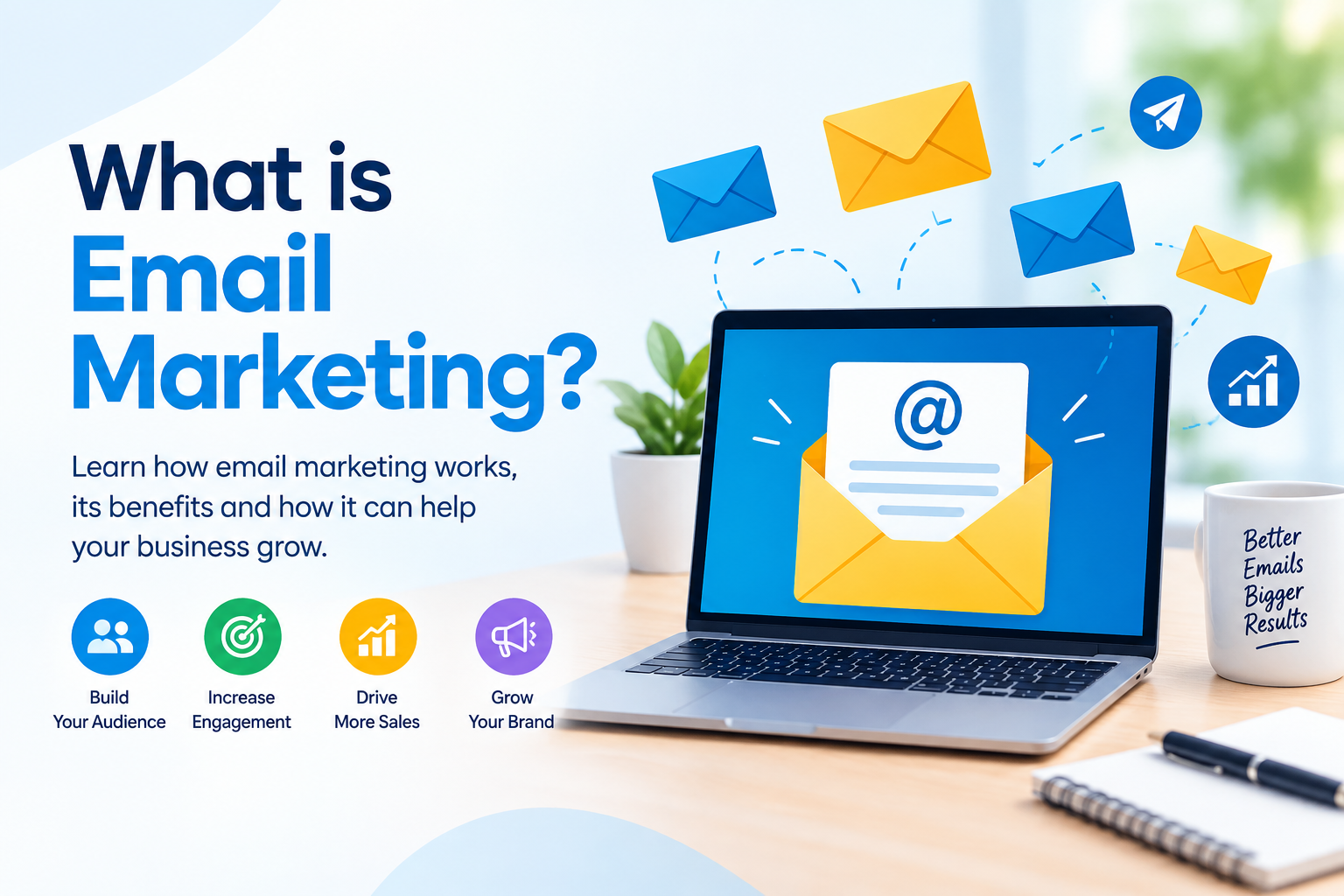
What Is Email Marketing?
What is email marketing , really? A direct line to your audience’s inbox, without renting space from an algorithm. Here’s everything a beginner needs to send their first campaign — and their best one.
What Is Email Marketing?
Email marketing means sending targeted emails to a specific list of subscribers. The goal can vary — promoting a product, building relationships, sharing content, or driving an action like a purchase, registration, or click.
Unlike social media, which means renting a space from another company and trying to get noticed amidst the algorithms of that particular website, email marketing allows you to connect directly with your audience via their email boxes. Once someone gives you their email address, they’ve handed you a personal channel of communication — and that’s highly valuable.
Generally, email marketing can be divided into various types, and while each of them may serve a different purpose, there’s one thing they all have in common.
Promotional
Those that include deals, discounts, and special offers.
Newsletters
A scheduled email that informs about something new.
Transactional
Includes order confirmation emails and password reset.
Triggered
Automated (or triggered) emails send themselves based on a subscriber’s action, like signing up or abandoning a cart.
Lifecycle
It includes welcome emails and onboarding emails.
Why Email Marketing Still Matters in 2026
Email marketing works best as part of a broader digital marketing strategy, rather than as a standalone tactic. However, there is one statistic that requires no explanation. Many industry studies show a typical return of $36 to $42 for every dollar spent, depending on industry and execution. Few channels come close.
You own your list
Social media can alter its algorithm within an instant’s notice. Your email list is an asset you control — no algorithm decides whether a subscriber sees your message.
Higher engagement
People who subscribe have already shown interest. Your audience is warmer and more likely to convert than cold traffic from ads or search.
Personalization on a grand scale
In today’s technological age, you can personalize your emails by splitting up your target market, whether you have 100 or 100,000 customers.
Cost-effective
Compared to advertisements, email marketing is much cheaper.
How Does Email Marketing Work?
On the surface, email marketing functions via an iterative process that has been developed in time to separate beginners from experts.
Make a list
Collect emails from your website, social networking, or even in person.
Segment
Sort the subscribers by their interests or behavior.
Create content
Write emails that give value to your audience.
Send
Either send emails by hand or via automation.
Track
Monitor factors like open rate, click-through rate, un-subscriptions, and conversions.
Optimize
Optimize for the next email delivery with the help of data collected.
Key Terms Every Beginner Should Know
A short glossary to help you read your dashboard with confidence from day one.
- Subscriber
- A person who has opted in to receive your emails.
- Open Rate
- Percentage of people that have opened your email.
- Click-Through Rate
- Percentage of people that clicked on a link in your email.
- Conversion Rate
- The percentage who completed a desired action.
- Bounce Rate
- Measures the percentage of emails that failed to deliver.
- Unsubscribe Rate
- Shows how many people opted out after receiving an email.
- ESP
- Email Service Provider – the medium via which campaigns are delivered.
- Segmentation
- Breaking your list up into segments based on similarities.
How to Start Your Own Email Marketing Campaign?
Below is a simple and complete guide on how you can start your own campaign from scratch.
Choose an email service provider (ESP)
Before choosing your ESP, make sure your website is properly hosted and technically sound, since most ESPs integrate directly with your site for forms and tracking. The most popular ESPs include Mailchimp, ConvertKit, Klaviyo, ActiveCampaign, and Brevo. Consider the following factors about each of them: user-friendliness, automation capabilities, cost, app integration, and analytics.
Generate email addresses legally
Never in any case buy email addresses as it might have a negative impact on deliverability and could actually be illegal. Rather generate your email list organically using:
- Lead magnets: free eBooks, checklists, and templates
- Pop-ups/ embedded subscription forms on websites
- Landing pages
- Social media promotion
Segmentation of your audience
Split up your email list based on purchasing behavior, level of engagement, geographic location, interests, etc.
Write your email
Elements that form the essential components of a good email include – an attractive subject line, opening line, body, call-to-action and responsiveness.
Create campaigns automatically
Create automatic email campaigns based on the actions of the recipients – welcome emails, cart abandonment emails, post-purchase follow-up emails, and reactivation emails for inactive leads.
Testing and optimization
Do A/B testing of your email campaign’s subject line, timing, design, CTA, and personalization – small changes can have a significant impact.
Performance and optimization
See what your open rates, click-through rate, conversion rate, and unsubscribe rates are and try to learn from it.
Best Practices for Effective Email Marketing
Permission-based only
Always use opt-in methods to build your list, and keep engagement higher.
Personalize beyond a name
Use behavior and purchase history to make content feel individually relevant.
Stay consistent
Consistency can take place weekly, bi-weekly, or even monthly.
Optimize for mobile
Most emails are opened on phones — design responsively from the start.
Be truthful in subject lines
Bait increases clicks initially but hurts credibility in the long run.
Purge your list occasionally
The smaller, active list works better than a big list that is inactive.
Common Mistakes to Avoid
Even experienced marketers slip up here. Steer clear of these as you get started.
TO SENDER
Sending too frequently
Overloading subscribers leads to fatigue and higher unsubscribe rates.
TO SENDER
By ignoring segmentation
There will only be one message for everybody.
TO SENDER
Neglecting mobile
A poorly formatted email on mobile turns readers away instantly.
TO SENDER
Skipping A/B tests
Without testing, you’re guessing instead of deciding with data.
TO SENDER
No clear CTA
If readers don’t know the next step, most won’t take one.
TO SENDER
Buying email lists
Damages deliverability and violates most ESP terms of service.
The Future of Email Marketing
Email marketing keeps changing as technology changes. In addition, artificial intelligence is being used by marketers to create good subject lines, to predict when an email should be sent, and also to personalize the emails. There are also interactive emails that have been seen recently. These emails may contain polls, carousels, or even a small shopping experience.
While this technology is growing rapidly, one thing that hasn’t changed yet is the need for providing value, respecting the subscribers’ preferences and building their trust.
Frequently Asked Questions
Quick answers to the questions beginners ask most before sending their first campaign.
1Will Email Marketing Be Effective in 2026?
Yes. It remains one of the highest-ROI channels available, with typical returns of $36–$42 for every dollar spent. Unlike social platforms, you own your list and aren’t subject to algorithm changes.
2How much does email marketing cost to start?
All e-mail service providers offer free subscription packages for small lists (500-1,000 subscribers, typically), making email one of the cheapest methods of marketing to try out. Fees will grow progressively as you increase your list size.
3How will I create my email list from scratch?
Provide something of value in return for an email address by using a lead magnet, discount, or other special offers by using popups on the website, landing pages, or even through social media. Do not ever purchase a list; it is detrimental to delivery rates.
4What would be a good open rate for a beginner?
The open rates vary by industry, but many beginners consider 15-25% open rates to be enough initially. It depends on the quality of the subject lines, reputation of the sender and subscriber list.
5How often should I send emails to my subscribers?
There is no exact answer to this question because the frequency of sending emails is less critical compared to consistency. Many companies start by sending emails weekly or twice a week and make adjustments accordingly.
6What is the best email marketing service for beginners?
There are various email marketing tools available to start out since they offer a free plan and have an easy-to-use interface. But, the best service will vary depending on the number of subscribers you have.
CLASS
Ready to send your
first campaign?
Email marketing is not only a strategy; it is also a relationship builder and becomes more powerful every time you gain another subscriber. Go slow but steady and let the mailbox do its job.